Baby Has Dent on Head Like a Headband
What Is Craniosynostosis?
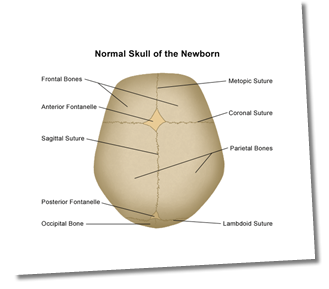
The normal skull consists of several plates of bone that are separated by sutures. The sutures (fibrous joints) are institute between the bony plates in the head. The office of the suture is to let molding through the birth culvert and
adjustments for the growing brain. As the infant grows and develops, the sutures shut, forming a solid piece of bone, called the skull.
Craniosynostosis is a condition in which the sutures close prematurely, causing problems with normal brain and skull growth and premature closure of the fontanelles (soft spots). Premature closure of the sutures may too crusade the pressure inside of the head to increase and the skull or facial basic to change from a normal, symmetrical appearance.
What are the symptoms? The most common sign of craniosynostosis is an oddly shaped head at birth or by the time the child is a few months old. For instance, the skull may become long and narrow. Or it may be very apartment and broad in front or back or on the sides. This oddly shaped head may be the merely sign of craniosynostosis.
In rare cases, the deformity causes pressure to build up on the baby'south brain. This can cause brain impairment and can make the infant develop more slowly than other children.
Sagittal Craniosynostosis 
Sagittal Craniosynostosis is the well-nigh mutual type of Cranioysnostosis (40%-58% of all cranio cases) and effects more than males than females. Early closure of the sagittal suture results in scaphocephaly. Infants will often have a protruding forehead, an elongated head, and protruding at the back of the skull.
Coronal Craniosynostosis
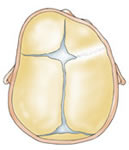
Coronal Craniosynostosis is the second near mutual form of Craniosynostosis and furnishings mostly females. Coronal synostosis may occur on either side or may be bilateral. Infant will oftentimes have an tiptop of the eye socket, flattening of the ridge of the eye and displacement of the nose on the afflicted side.
Metopic Craniosynostosis 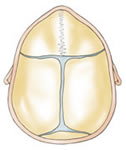 Metopic synostosis is the third about mutual form of Craniosynostosis and is associated with trigonocephaly with a male person preponderance. The metopic suture is located between the soft spot and the olfactory organ. Early closure of this suture results in trigoncephaly. Infants will often have a prominent ridge downwardly the middle of the forehead, a pointed forehead, and optics that seem too close together.
Lambdoid Craniosynostosis
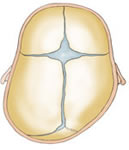
Lambdoid Craniosynostosis is one of the most rare type of Craniosynostosis. Nigh cases of lambdoid craniosynostosis are unilateral and result in asymmetric posterior plagiocephaly that needs to exist differentiated from positional plagiocephaly.
Frontosphenoidal Craniosynostosis
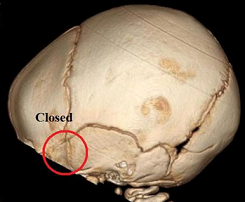
Frontosphenoidal synostosis is one of the virtually rare types of Craniosynostosis. Information technology is the small suture close to the centre socket. Premature closure of this suture volition result in flattening on the side of the front end of the head and tin cause an indentation virtually the temple or eyebrow bones. Frontosphenoidal appears almost exactly like coronal craniosynostosis simply the coronal sutures are open. This is believed to be ane of the near undiagnosed forms of cranio as a child tin can appear to have coronal synostosis or positional plagiocephaly but the CT scans will show the sutures are non fused and the kid will not exist diagnosed correctly.
Multiple Suture Craniosynostosis
Craniosynostosis of multiple sutures accounts for approximately 5% of craniosynostosis. A child tin can have 2 or more sutures fused prematurely and is a more than complex grade of craniosynostosis. Complex craniosynostosis often causes increased inter cranial pressure level and is associated with developmental delay and a high charge per unit of re-functioning.
Positional Plagiocephaly (Flat head syndrome)
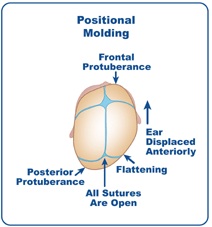
Plagiocephaly (PLAY-gee-oh-SEF-uh-lee) is a apartment spot on the back or side of a infant's caput. It is caused by pressure on the bones of the skull earlier or after nascence. This usually happens because of the way a baby likes to prevarication (their positional preference) in their first few months of life.
There are many things that could cause positional plagiocephaly.
Children with multiple medical problems or delayed evolution may take a difficult time changing positions. They are more probable to develop positional plagiocephaly than children who can motion effectually more.
Some infants have a stiff preference to look in one direction. This can lead to a express range of motion in the neck from muscles being tight. This is called torticollis. Babies with torticollis might be more likely to develop plagiocephaly than other babies, since they always rest on the aforementioned spot on the back of their head.
Premature infants are sometimes more than likely to develop plagiocephaly. This is considering their skull bones are softer than the skulls of babies born at full term. They also tend to move their heads less often.
Positional Plagiocephaly does not require surgery and can commonly be fixed by repositioning of the babies head while they lay downwardly or sleep and some may require the use of a helmet.
More data on Craniosynostosis click here
More information on Plagiocephaly click here
silversteinonch1942.blogspot.com
Source: https://craniocarebears.org/what-is-craniosynostosis/

Post a Comment for "Baby Has Dent on Head Like a Headband"